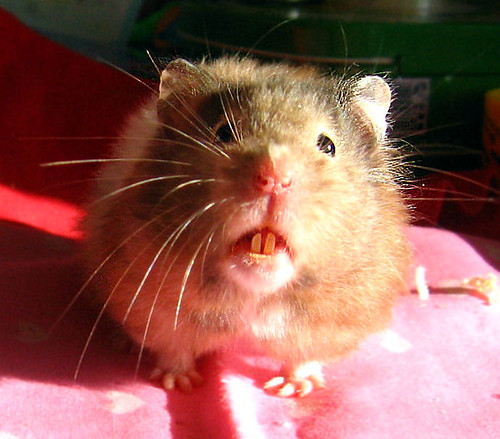
Why A Hamster? In a survey conducted by the American Pet Products Manufacturing Association, the hamster has consistently been voted the most popular small pet of the year 1990s. Most People who have cast their votes for the hamster feel that they are fun to watch, and they are good, educational pets for children.
Memaparkan catatan dengan label What is Hamster?. Papar semua catatan

Sabtu, 20 September 2008

Types of Hamster


Syrian Hamsters

The big guys that are about 5-7" long and weigh 4-7 oz. on average. Their tails are almost bare and their feet have fine fur on the top, but none on the bottom -- just bumpy pads. They can have many different colors and patterns and long or short fur. Syrian hamster sometimes called "golden hamsters" as well as stupid pet-shop nicknames like "black bears," "teddy bears," "fancy hamsters," "Dalmatians," "panda bears," and other dopey or misleading terms. They must live individually by the time they're 6-8 weeks old or they will kill one another. They're the easiest of the species to handle, and perfect for first-time owners. Of course children will need supervision handling any pet, and hamsters are delicate enough to make this especially true. The smaller four species can live in same- or opposite-sex pairs or small colonies if they're same-sex siblings from the same litter or if introduced carefully when young. Their temperaments and habits are different enough that they must live only one species to a cage. Pairs or groups may have to be separated if fights or bullying ensues, so it's essential to have an extra cage on hand just in case.


Dwarf Campbells Russian Hamsters

Dwarf hamsters are the most common type of hamster that were adopted as pet. They are cute, easy to care and most importantly they are funny. Their act and behavior will surely make you smile or even laugh. They move fast and playing at most of their time. One of my dwarf hamster always run in a small circle at full speed for a minute and then stop for a while for a break lying on it's back with all legs up and then continue running like mad scattering away the bedding.
Usually, dwarf hamsters are 2.5-4" long and weigh 1-3 oz. on average. They have stubby little furry tails and fur on both the tops and bottoms of their feet. There are many different colors and patterns. They're sometimes called "Siberian dwarfs," but this is a common pet-store misnomer. They're also called things like "fancy dwarf hamsters," "blueberry hamsters," "blackberry hamsters" and other cutesy, inaccurate names.

The Campbell’s breed by large commercial breeders have given the dwarfs a bad reputation as being Nippy biters. This is not so as most Campbell’s are friendly inquisitive little animals that like to be held. The biting trait is I believe inherited. And by carefully selecting only animals that don't bite I have breed this trait out of my Campbell’s. I do have several females that will nip if they have babies. But that is to be expected of any animal with babies.

Campbells Dwarfs have been Breed in captivity Scene 1963 originally as Laboratory animals Possible references to dates as early as 1943 I am researching this. As A result there are now a number of Coat and Color Mutations available


Roborovski Dwarf Hamster

Scientific Name: Phodopus Roborovski
Country of Origin: Central Asia, Northern Russia, Mongolia, and Northern China
Lifespan: About 3 to 3 1/2 years
Size and Weight: 4 to 5cm and 20g to 25g
Other Important Facts:

The Roboroski hamster is becoming increasingly more available in pet stores. It is fast and very lively, but rarely nip. This hamster is not normally recommended to the first time hamster owner, as they can be tricky to handle. Roboroski hamsters are very sociable and should be bought in pairs of the same sex although many pet stores cannot sex these hamsters confidently. Roboroski hamsters should never be housed in small cages despite their small size and require at least a 24" X 12" glass tank or plastic cage. They should never be housed in barred cages, because they will squeeze through the bars or may get half stuck.


Siberian or Winter White Russian dwarf hamsters

These little guys are hard for some to distinguish from the Campbells. One key is that they come in a much smaller number of colors and patterns. None of the known mutations have red eyes, for example -- only Campbells have those. There are a few other distinguishing characteristics, but the distinction is best made in photos and is covered well at the link below. Winter Whites are also good first hamsters, but for older children and adults, since younger kids may have trouble handling the smaller species. Pet shops sometimes mix the two dwarf Russian species in tanks, but that creates constant friction with potentially deadly consequences. The two dwarf Russian species are the only two species of hamsters that can interbreed, but doing so weakens each species, and the practice of hybridization is warned against by many.


Chinese mouse like hamster

Longer, thinner, lighter hamsters with a bit more tail than the Russian dwarfs. These guys are best suited to experienced owners, and are unusual finds in pet shops in the U.S. They can live in closely monitored pairs or small groups, but the balance of dominance is often delicate, and separations are more likely to be necessary than with dwarf species. Of course, a knowledgeable breeder would be more likely to provide carefully reared, closely bonded pairs.

The Evolution of Hamsters

While a great deal is known and understood about the whys and wherefores of rodents, our pet hamster species have remained somewhat elusive members of that family tree because of their wild ancestors solitary, secretive lifestyles. As is true of all rodent pets, the hamster's true beginnings are found in the wild, yet because of his tendency to burrow and spend a great deal of time underground, he was able to shield himself from prying humans for thousands of years. Consequently, the hamster is a relative newcomer to the roster of known animal species in general and pets in particular.


The classic golden, or Syrian, hamster, is the native desert rodent that evolved into several different known species of hamsters - twenty-four, to be exact - and only a few of these are kept as pets. Hamsters in general were traditionally found in a variety of regions from mountains, to deserts, to agricultural fields. As a member of the adaptable rodent family, the hamster has been ever-nimble in his ability to deal with the elements, resulting in the evolution of a large and impressive band of hamster species.

Within the rodent order, there are several suborders, the hamster being a member of the suborder Myomarpha, the mouse like rodents. This includes the various hamster species, raging in size from the tiny dwarfs that measure only 2 to 4 inches in length, to the fascinating common hamster, the grandaddy of the family, that may reach lengths of up to 8 to 11 inches, to the ever popular golden hamster that sits somewhere between the two in size.

Rodent Reproduction


To further ensure that their species survive through eternity, especially when confronted daily by successful predator species that range from foxes to bears to humans, rodents are phenomenally quick breeders. Most species reach sexual maturity within a few weeks after birth, and if left to their own devices, rodents begin reproducing right away. As though driven internally to pass on their genetic blueprints to future generations, rodents typically produce large litters and often find themselves caring for two or three generations just weeks apart in age.

Isnin, 15 September 2008

Physical Characteristics


The Teeth

On a more scientific plane, we can tell a rodent, any rodent, by its teeth. te name rodent, in fact, is derived from the Latin word rodere, which means "to gnaw". While the various rodent species are differentiated by variations in color, size coat type, behavior, sleeping habits, social structure and dietary preferences, all share a common characteristic in their front teeth ( incisors).

The rodent incisors are marvels of engineering that continue to grow throughout the individual rodent's life. The jaw is structured to ensure that the rodent's life. The jaw is structured to ensure that rodent can constantly gnaw in order to keep its chisel - like incisors filed. This gnawing also allow those incisors to contact the lower set of teeth at just the right angle to finish the job. If the incisors are not properly filed - which will happen in the unfortunate rodent with a misaligned jaw - the animal will starve to death and suffer a great deal of pain in the meantime, as his teeth continue to grow and pierce various regions of his mouth and face.


Hip Glands

Another characteristic that hamsters have is two large glands on each side of their body, close to the position of their hips. Males have larger glands than female hamsters. The glands secrete a substance that is oily and acts as a territory marker. Their fur usually hides the glands, but sometimes a wet spot or matted fur will indicate the location on the hamster's body.

Some hamsters may rub themselves against the sides of their cage, imitating instinctual territorial behavior. Hamsters in the wild rub themselves against the walls of their burrows to mark their presence. Hamsters have a mild musk scent that can be detected as times when their glands are actively secreting. Since their eyesight is not strong, hamsters rely upon these markings to discern their territory from other hamsters.

Survival Techniques


Because more are relatively small size, rodents may often reside somewhat unobtrusively in the midst of human domiciles, often living right under human noses for weeks or even months before a telltale chewed corner of a sack of flour or bird seed alerts their two-legged hosts to their presence.

Diet also played a key role in rodent survival. Their physiological makeup enables most rodents to thrive on a variety of foodstuffs, thus ensuring that even when their favored or traditional dietary items disappear, there are always alternatives available. Most rodents can survive on veritable smorgasbord of options, including vegetarian fare or foods of animal origin including insects and worms.


In terms of physical similarities, most rodent species are relatively small and compact. They use their delicate little "hands" to carry out a variety of functions, including collecting and manipulating food and grooming. Some rodents, such as the hamster, are graced with ample cheek pouches, in which they can store large amounts of food to hide away for a time when food is not plentiful - a rainy day, if you will.

Sabtu, 13 September 2008

Rodents and Humans


Imagine a vast forest, home for centuries to a complex, interconnected ecosystem of thousands of birds, mammals, insects and plants. Now imagine that forest is razed for cattle grazing or stripped for building identical tract homes. Just where do those resident animals go?


Those species that cannot adapt to human encroachment into their habitats are doomed either to displacement because of the loss of their food supplies and living space, or to outright destruction. This latter fate has typically resulted from intentionally destruction by inter looping humans, predators themselves, who have historically viewed their non human counterparts on the food chain as competition.

To their credit, rodents for the most part, even those targeted just as vigorously for destruction, have not suffered the same sad fate as the predators. In fact, they have generally emerged survivors of human activity.

The names of only a few of the planet's hundreds of rodents species appear on the various lists that track the threatened an endangered species of the world. In light of the condition of most animal populations today, that is truly amazing. While individuals who do not care to coexist with mice, rats and their brethren may not be impressed by this fact, even they must admire how nature has enabled these rodent survivors to persist so efficiently.

What is Hamster?


The Hamster is a member of the rodent order of mammals in the vast sea of species that compromise the animal kingdom. The rodent order is, in fact, the largest of all mammal species are rodents, and almost all of those species are quite large in number.

While rodents tend to be stereotypically regarded as pests in the eyes of humans (particularly rodents of rat and mice varieties), theirs is an amazing group of animals found all over the globe in all geographical regions and climates. Humans have access to great deal of information about various species of rodents, because where there are humans, there are probably rodents close by.


Rodents tend to live proximity to humans--a testament to rodent adaptability. As human populations have spread through the ages, they have invari-ably overtaken lands that were originally occupied by nonhuman animal species. Some species have survived the enroachment while a great many others have not.

Rodents are associated with gnawing; hence their name in Latin,rodere, which means to gnaw. They are able to gnaw so well because of their characteristic teeth that are designed for this jaw movement - one pair of upper and one pair of lower incisor teeth. Rodents are the most numerous of all mammals - 50% os all mammals can be found in the order Rodentia.

Unfortunately, they are known for carrying disease and parasites and are associated with spreading (due to the fleas they carried) the Black Plague throughout Europe. To this day , the possibility of a rodent invading our food supply, home and/or workplace has caused concern for humans. If the telltale sign of a gnawed cardboard box seen, many of us panic and start setting traps. Usually all that needs to be done to control their presence, however, is to store food correctly in secure, airtight containers.

Rodents have been domesticated for many thousands of years. It is interesting to note that if weren't for wild rodents, we might not have the domesticated cat. Cats were called upon to control rodent population and thus became tame and were considered part of household. Our paths will always cross with rodents because they are attracted to our food.


LinkWithin

Related Posts with Thumbnails